What Is a Food Heat Seal Tester?
A food heat seal tester is an instrument that measures the peel force required to separate a heat-sealed joint in flexible food packaging, verifying that seals meet strength specifications under ASTM F88 and related standards. If you work on a factory floor and your packaged product fails at the sealer, you already know what a compromised seal costs — premature spoilage, rejected pallets, and in the worst case, a full recall.
Seal integrity is not a nice-to-have. It directly determines product shelf life, food safety, and FSMA compliance. A heat seal strength tester — also called a packaging seal tester or heat seal peel tester — gives your QA team the data needed to prove that every sealed package leaving your line meets spec. The alternative is shipping a 24% at-risk product rate, which is exactly what WRAP found in factory studies of flexible packaging operations.
How a Food Heat Seal Tester Works
The core measurement is straightforward. You cut a 25.4 mm (1-inch) wide strip from the sealed area of your package or test sample. One film layer goes into the upper grip, the other into the lower grip. The instrument pulls at a controlled speed — 200 to 300 mm/min per ASTM F88 — at either a 90° or 180° peel angle until the seal separates. Software records peak force and average peel force, outputting results in N/15mm or lbs/inch.
That peel test tells you seal strength after cooling. But food packaging QA often requires more than one data point.
For new film qualification, you need to characterize the full heat seal curve — a plot of seal strength against sealing bar temperature. A lab heat sealer (governed by ASTM F2029) creates controlled test seals at programmed combinations of temperature, pressure, and dwell time. From those test seals, you map the seal initiation temperature (SIT): the lowest temperature at which seal strength rises sharply above baseline. Above SIT, strength plateaus. Above the upper limit, film degrades or blocking occurs. That range between SIT and upper limit is your heat seal operating window. A wider window means a more process-robust film — and a more forgiving production line.
For vertical form-fill-seal (VFFS) snack and coffee lines, hot tack is the critical variable. Hot tack is seal strength measured within 150 milliseconds of seal formation, before the film cools. If hot tack is too low, product weight falling through the seal immediately after formation will cause seal failure — even if ultimate seal strength is adequate. ASTM F1921 governs hot tack testing.
| Test Mode | Standard | Measures | Food Application |
|---|---|---|---|
| Seal Strength | ASTM F88 | Peel force (N/15mm) after cooling | All flexible food packaging |
| Hot Tack | ASTM F1921 | Immediate peel force post-seal | VFFS snack/coffee lines |
| Controlled Heat Sealing | ASTM F2029 | Seal curve, SIT, operating window | Film qualification |
| Bubble Leak | ASTM F2096 | Gross leak detection (≥250 µm) | MAP pouches, retort trays |
| Dye Penetration | ASTM F1929 | Fine channel leaks (≥50 µm) | Lidstock, peelable seals |
Why Food Manufacturers Cannot Skip Heat Seal Testing
Let's start with the number that should be on every QA manager's desk: the WRAP study found that 24% of heat seals at the factory gate were either already leaking or at serious risk of integrity failure during the supply chain. One in four packages. That is not a process optimization problem — that is a line stoppage waiting to happen.
In the first half of 2025, packaging defects drove food recalls involving tens of millions of units across major CPG brands. Packaging Digest's Q2 2025 analysis identified seal failure as a leading root cause, with zipper and resealable closure areas accounting for 80% of documented leak events. If your line runs any format with a zipper — stand-up pouches, resealable snack bags — your highest-risk seal point is already identified.
For Modified Atmosphere Packaging (MAP), the tolerance for seal failure is near zero. A micro-leak that allows oxygen to infiltrate a MAP ready meal or fresh meat tray can shift residual O2 from below 0.5% to near-ambient levels. For a product designed for a 30-day shelf life under MAP conditions, every 1% oxygen infiltration can shorten shelf life by three to five days. A small leak does not produce a slightly shorter shelf life — it can effectively destroy the MAP benefit entirely.
The regulatory picture adds another layer. FSMA Preventive Controls rules require documented food safety plans, and seal integrity is explicitly part of the hazard analysis for biological hazards from spoilage. Test records from a food heat seal tester are not just good QC practice — they are your documented preventive control. Major retailers and club stores now require submitted ASTM F88 test reports as part of supplier qualification. Without them, you do not get on shelf.
The cost argument is simple. A single recall event runs into millions of dollars in direct cost, plus brand damage that compounds for years. A heat seal tester purchase is typically less than 1% of the cost of one recall event. The root causes of seal failure identified by WRAP — contamination in the sealing zone, wrong temperature/pressure/dwell parameters, and mechanical seal bar wear — are all detectable with regular peel testing and packaging integrity testing before product ships.
Key Standards for Food Heat Seal Testing
Every test your lab runs needs to trace back to a recognized standard. Here are the six standards that cover the full food packaging seal testing workflow:
ASTM F88 / F88M — The primary peel strength standard for flexible barrier materials. Specifies specimen width (25.4 mm), grip separation speed (200–300 mm/min), peel angle (90° or 180°), and result reporting in N/15mm. This is the standard your retailers and auditors are asking for. It is the baseline competency any food packaging QA lab must have.
ASTM F2029 — Standard practices for making controlled heat seals to characterize heat sealability. Without F2029 methodology governing how your test seals are made, your F88 peel data lacks reproducibility. These two standards always work together.
ASTM F1921 — Hot tack test method for polyolefin films. Tests peel strength within 150ms of seal formation. Essential for VFFS line qualification — snack bags, coffee pouches, any format where product weight loads the seal immediately post-formation.
ASTM F1929 — Dye penetration method for detecting seal leaks. Detects channels as small as 50 µm. Methods A (dye injection), B (edge dip), and C (eyedropper application) suit different package geometries. Food labs use F1929 for peelable lidstock QC and for investigating suspected microleaks in MAP products.
ASTM F2096 — Bubble emission (internal pressurization) leak test. Detects gross leaks of 250 µm or larger. Fast, cost-effective, and well suited for whole-package integrity screening of MAP pouches and retort trays. At 10–17 kPa test pressure, it will catch any leak that could compromise gas composition in MAP packaging.
ASTM F2824 — Mechanical seal strength for round cups with peelable lids. If you produce or supply yogurt cups, dairy containers, or ready meal trays with peel-off lids, F2824 is the method that governs consumer open-force validation.
Test records generated under these standards function as documented preventive controls under FSMA, giving your food safety plan the traceability regulators expect.
KHT HS-Pro: Purpose-Built for Food Packaging QA
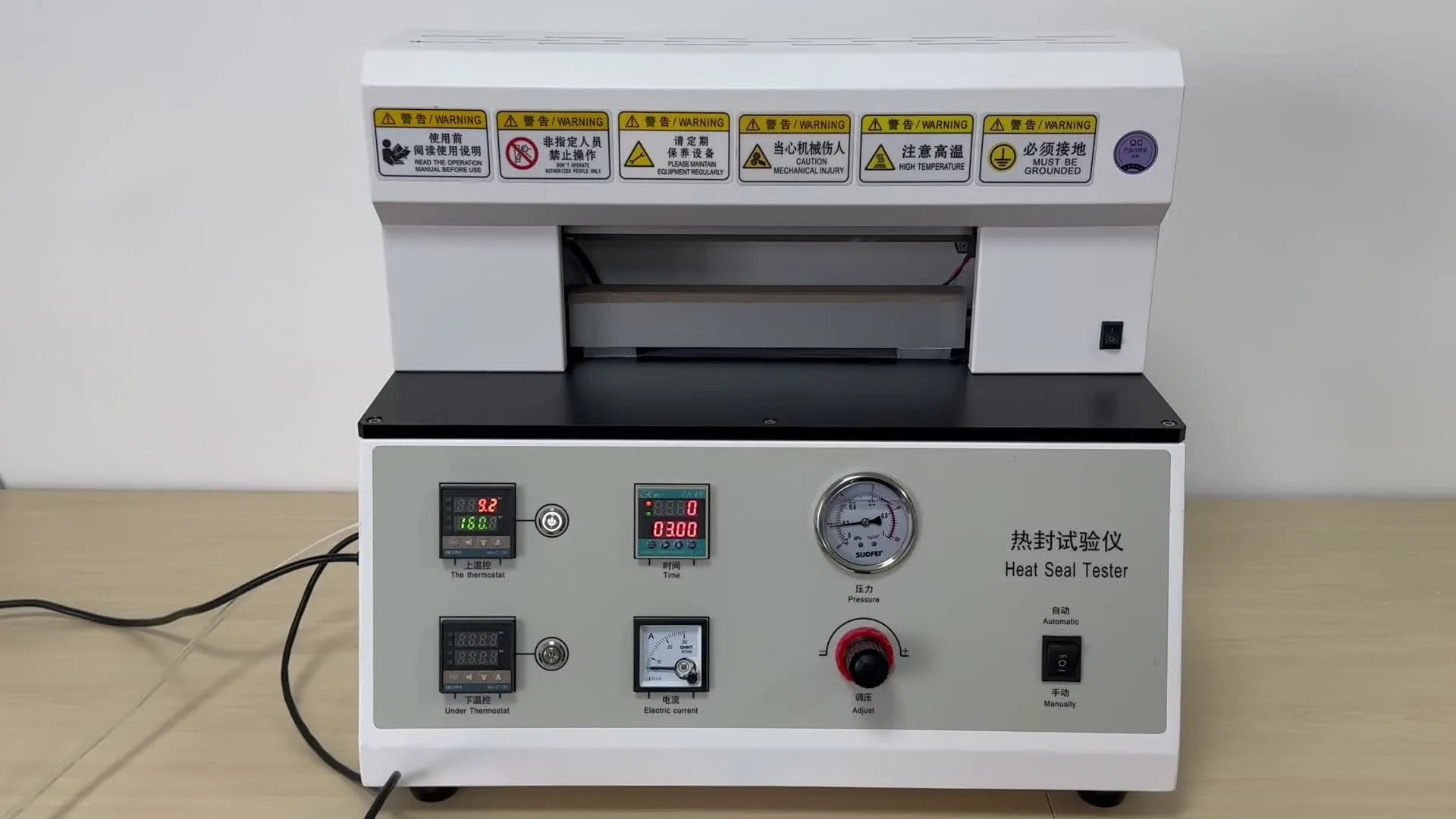
On the factory floor, instrument versatility directly translates to workflow efficiency. The HS-Pro series from KHT Instrument combines the lab heat sealer (ASTM F2029) and the peel tester (ASTM F88) in a single benchtop footprint — which means your QA technician runs incoming film qualification, SIT curve generation, and routine seal strength checks without moving between workstations or managing two separate instruments.
The sealing unit runs from 50°C to 250°C with ±0.5°C temperature control. That precision matters because SIT can shift by as little as 5°C between film lots from the same supplier. If your control is ±8°C, you cannot reliably detect that shift before it causes production problems. Dwell time is programmable from 0.1 to 99 seconds; sealing pressure from 0 to 0.8 MPa. Those three variables — temperature, dwell, pressure — are the levers your SOP needs to be locked down and documented.
For peel testing, the 500 N load cell covers the full range from fresh produce flow wrap at 1.5 N/15mm up to retort pouches at 20 N/15mm. Speed is variable from 10 to 500 mm/min; both 90° and 180° peel fixtures are included for full ASTM F88 compliance. Optional shuttle jaw adds hot tack capability (ASTM F1921) for lines running VFFS formats.
The software side is where the throughput advantage shows. The HS-Pro generates a complete SIT and heat seal operating window chart automatically from a temperature-step batch run — no manual plotting. SPC dashboard, pass/fail limit configuration, CSV and PDF report export, and a full audit trail are built in. For FSMA documentation, the audit trail means your test records are timestamped, operator-attributed, and ready for regulator review.
For a full selection of food packaging seal testers, visit KHT Instrument — Heat Seal Testers.
| Parameter | HS-Pro Specification |
|---|---|
| Sealing Temperature | 50–250°C (±0.5°C accuracy) |
| Dwell Time | 0.1–99 seconds |
| Sealing Pressure | 0–0.8 MPa |
| Load Cell Capacity | 500 N |
| Peel Speed | 10–500 mm/min |
| Peel Angle | 90° and 180° |
| Grip Width | 25.4 mm (1 inch) standard |
| Standards Compliance | ASTM F88, F2029, F1921, F1929, F2096 |
| Data Output | CSV, PDF, SPC chart |
| Power | 220V/110V, 50/60Hz |
Seal Strength Benchmarks by Food Packaging Format
On the factory floor, knowing your target range before running a test batch saves hours of trial-and-error. The tables below are working reference values — not substitutes for your own film qualification data, but a solid starting point for setting pass/fail limits and flagging anomalous results.
| Food Packaging Format | Seal Strength (ASTM F88) | Notes |
|---|---|---|
| Snack bags / pillow pouches | 2.0–6.0 N/15mm | Easy-peel formats toward lower end |
| Coffee stand-up pouches | 4.0–10.0 N/15mm | Multi-layer laminate; CO2 pressure tolerance |
| Dairy lidstock (peelable) | 1.5–4.0 N/15mm | Consumer open-force optimized (ASTM F2824) |
| Yogurt cup seals | 2.0–4.5 N/15mm | Peelable; high-humidity environment |
| Frozen food pouches | 4.0–8.0 N/15mm | Freeze-thaw cycling stress |
| Ready meal trays (MAP) | 6.0–15.0 N/15mm | Lidstock + tray gas barrier |
| Meat vacuum/MAP pouches | 5.0–12.0 N/15mm | Oxygen barrier critical |
| Fresh produce flow wrap | 1.5–4.0 N/15mm | Light duty; transpiration ventilation |
| Retort pouches | 8.0–20.0 N/15mm | Autoclave pressure and temperature |
Peelable seals — dairy lidstock, yogurt cups, deli trays — are intentionally set at the lower end of the range. The engineering challenge there is not maximizing strength but hitting the consumer open-force sweet spot: strong enough for distribution, clean-peeling for the end user without angel hair or film tear.
For VFFS lines, hot tack minimum of 1.0–4.0 N/25mm is the practical floor. Below that threshold, the weight of product falling through the sealing zone immediately post-formation will split the seal before it cools.
SIT by film type tells you where to set your sealer:
| Film Type | Typical SIT | Notes |
|---|---|---|
| LLDPE sealing layer | 85–110°C | Common for snack bags |
| LDPE/EVA blend | 80–105°C | Dairy lidstock |
| Nylon/PE laminate | 140–170°C | Frozen/meat applications |
| PET/PE laminate | 130–160°C | Retort/ready meals |
The heat seal operating window should sit comfortably — at minimum — 15°C wide to give your production sealer adequate process margin across the shift.
Case Study: Reducing Seal Failures at a Ready Meal Facility
A mid-sized ready meal producer in northern Europe faced a 2.8% finished-goods leak rate discovered during a routine retailer audit. The investigation traced the problem to inconsistent sealing bar temperature — a ±8°C drift at shift changeover that no one was systematically measuring. The product was MAP-packaged with a 18-day shelf life claim, and compromised seals were allowing oxygen infiltration that effectively cut shelf life to 12 days before the audit caught it.
The fix was procedural as much as instrumental. The facility introduced the HS-Pro food heat seal tester into two points in the production workflow: incoming film QC at goods receipt, and end-of-shift production sampling. Every new film roll received a heat seal curve run. SIT was verified per roll. Production sealing temperature was then set 15°C above the measured SIT — into the middle of the plateau, not at the edge of the operating window.
Within six weeks, the leak rate dropped from 2.8% to 0.3%. The retailer audit passed. MAP shelf life claim was restored from 12 to 18 days. The pouch seal strength test data from each shift's sampling run became the documented preventive control record that the retailer's technical team reviewed during re-qualification.
The instrument paid for itself in the first month of production savings — before accounting for the avoided cost of the next recall event that the 2.8% rate was building toward.